Sunlight Isn't Just White
It looks white to the naked eye, but sunlight is actually a full spectrum of color - every wavelength from violet through red packed into a single beam. The best proof of this is a rainbow, where raindrops act as tiny prisms and separate those wavelengths into the bands we recognize. Earth's atmosphere does something similar, though less dramatic, every single day.
Each color of visible light has a different wavelength. Violet and blue light have short, tight wavelengths. Red and orange light have long, more relaxed wavelengths. That difference in wavelength is the key to everything that happens when light enters our atmosphere.
How Scattering Works in the Atmosphere
Earth's atmosphere is packed with gas molecules - primarily nitrogen and oxygen. When sunlight enters from space, it doesn't travel in a straight, uninterrupted beam. Individual photons collide with these molecules and scatter in all directions, like a cue ball scattering pool balls on impact.
This process, known as Rayleigh scattering, doesn't affect all wavelengths equally. Blue light, with its short wavelength, scatters far more aggressively than red light. The math is striking: blue light scatters roughly five to seven times more than red light per unit of atmosphere it passes through.
~40×
More atmosphere light travels through at the horizon
Compared to sunlight arriving from directly overhead, horizon-angle light passes through roughly 40 times more atmosphere before reaching an observer.
5-7×
How much more blue light scatters vs. red
Based on Rayleigh scattering calculations, blue light (~450 nm wavelength) scatters far more per unit of atmosphere than red light (~700 nm).
~400-700 nm
Range of visible light wavelengths
The human eye detects electromagnetic radiation across this nanometer range, from violet on the short end to deep red on the long end.
During the middle of the day, sunlight takes a relatively short, direct path through the atmosphere to reach your eyes. Blue light scatters in every direction - including toward you - which is why the sky overhead appears blue. Red and orange light, scattering far less, largely pass straight through and aren't spread across the sky the same way.
What Changes at Sunrise and Sunset
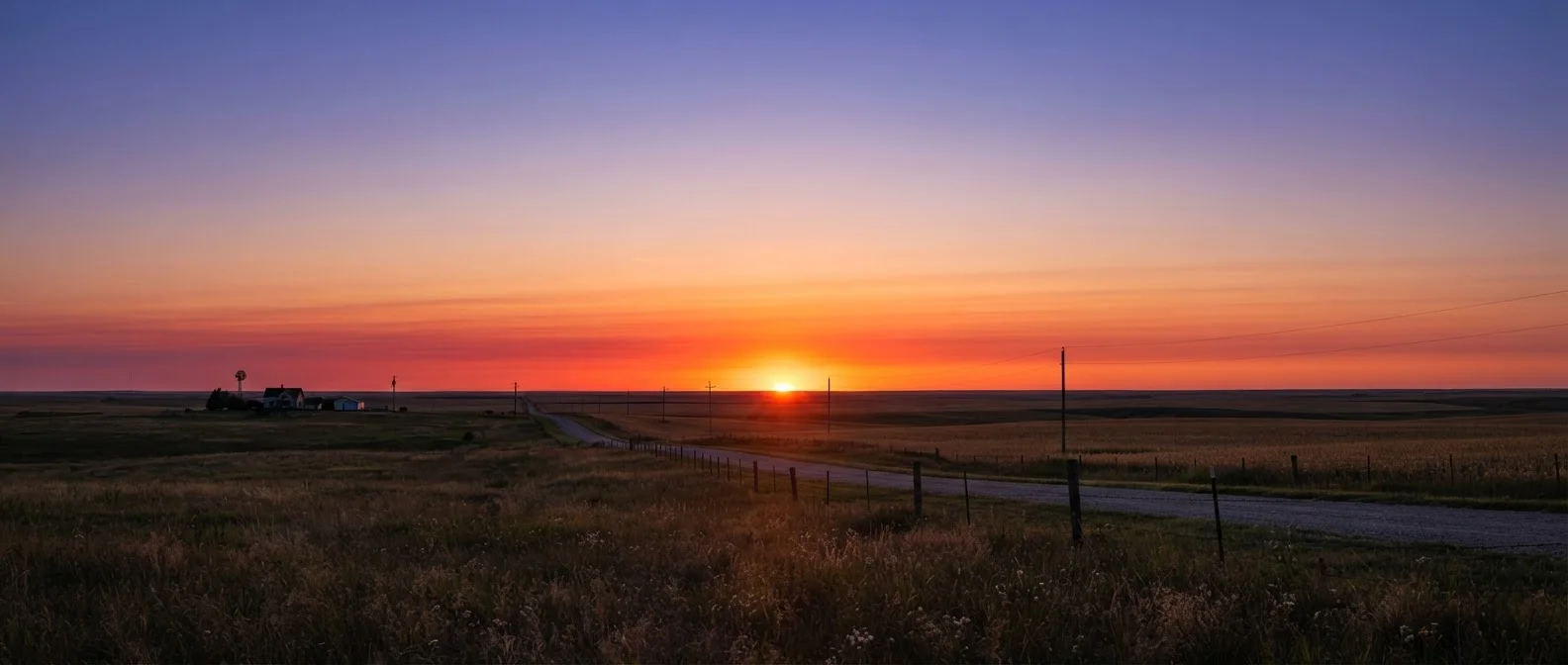
The geometry of sunrise and sunset is what transforms the color palette. When the sun sits near the horizon, its light enters Earth's atmosphere at an extremely shallow angle. Instead of cutting straight down through a relatively thin column of air, that light must travel diagonally through a much longer stretch of atmosphere - sometimes 40 times more air than when the sun is directly overhead.
That extra distance is a gauntlet for blue light. It gets scattered so many times, in so many directions, that almost none of it survives to reach your eyes directly from the sun's disk. What's left is the light that scatters least: reds, oranges, and warm yellows. Those long-wavelength photons punch through the full atmospheric path largely intact, painting the horizon in colors that feel almost theatrical.
“The atmosphere is not just a transparent shell around the planet - it is an active optical instrument, continuously filtering and redirecting light in ways that produce the colors we experience every day.”
— National Oceanic and Atmospheric Administration (NOAA), U.S. federal agency for atmospheric and oceanic science
The higher clouds and the sky above the horizon take on pink and purple hues because they are lit by that same filtered light and reflect it back toward observers on the ground.
Why Some Sunsets Are More Vivid Than Others
Not every sunset is equal, and atmospheric conditions explain the differences. Fine particles - from wildfire smoke, volcanic ash, desert dust, or even sea salt - add extra scattering agents to the atmosphere. They tend to scatter middle wavelengths like yellow and green more aggressively, leaving predominantly deep reds and saturated oranges.
The 1991 eruption of Mount Pinatubo in the Philippines, for instance, injected enormous amounts of sulfur dioxide into the stratosphere, producing unusually vivid sunsets around the world for months afterward. Closer to home, summer wildfire seasons across the western United States routinely produce some of the most dramatic evening skies that residents in distant states will ever see.
Humidity also plays a role. Water vapor and larger water droplets scatter light differently than dry air molecules do - a process called Mie scattering - which can produce softer, more diffuse glows rather than sharp, saturated reds.