Why Volcanoes Don't All Look - or Act - the Same
When most Americans picture a volcano, they imagine a steep, cone-shaped mountain spewing lava. That image fits one type reasonably well, but Earth hosts a diverse family of volcanic structures, each built by different magma chemistry, eruption style, and geological setting. Understanding these differences helps explain why Hawaii's lava flows are safe enough to watch from a distance while a Cascade Range eruption can level an entire mountainside in minutes.
The shape and behavior of any volcano is ultimately controlled by two factors: how viscous (thick or runny) its magma is, and how much dissolved gas that magma carries. Runny, low-gas magma produces gentle, effusive eruptions that build broad landforms. Thick, gas-rich magma traps pressure until it explodes, constructing steep cones - or blasting craters into the landscape entirely.
| Number of active volcanoes on Earth | Approximately 1,350 (Smithsonian Institution Global Volcanism Program) |
| Largest volcano by volume | Mauna Loa, Hawaii (~18,000 cubic miles) (U.S. Geological Survey) |
| Most volcanically active body in the solar system | Io, a moon of Jupiter (NASA Jet Propulsion Laboratory) |
| Youngest cinder cone documented | Parícutin, Mexico (emerged 1943) (USGS Volcano Hazards Program) |
| Age of Crater Lake caldera | ~7,700 years (collapse of Mount Mazama) (U.S. Geological Survey) |
| Height of Olympus Mons (Mars shield volcano) | ~72,000 feet (~13.6 miles) (NASA Mars Reconnaissance Orbiter data) |
The Main Volcano Types
Geologists recognize several primary volcano types, each with a characteristic profile and eruptive personality.
Shield Volcanoes
Shield volcanoes are the gentle giants of the volcanic world. Named for their resemblance to a warrior's shield lying flat on the ground, they are built almost entirely from low-viscosity basaltic lava that flows freely across vast distances before cooling. Eruptions are frequent but rarely explosive, making them among the most approachable volcanoes on Earth. Mauna Loa and Kīlauea in Hawaii are classic examples - Mauna Loa is, by volume, the largest volcano on the planet.
Stratovolcanoes (Composite Volcanoes)
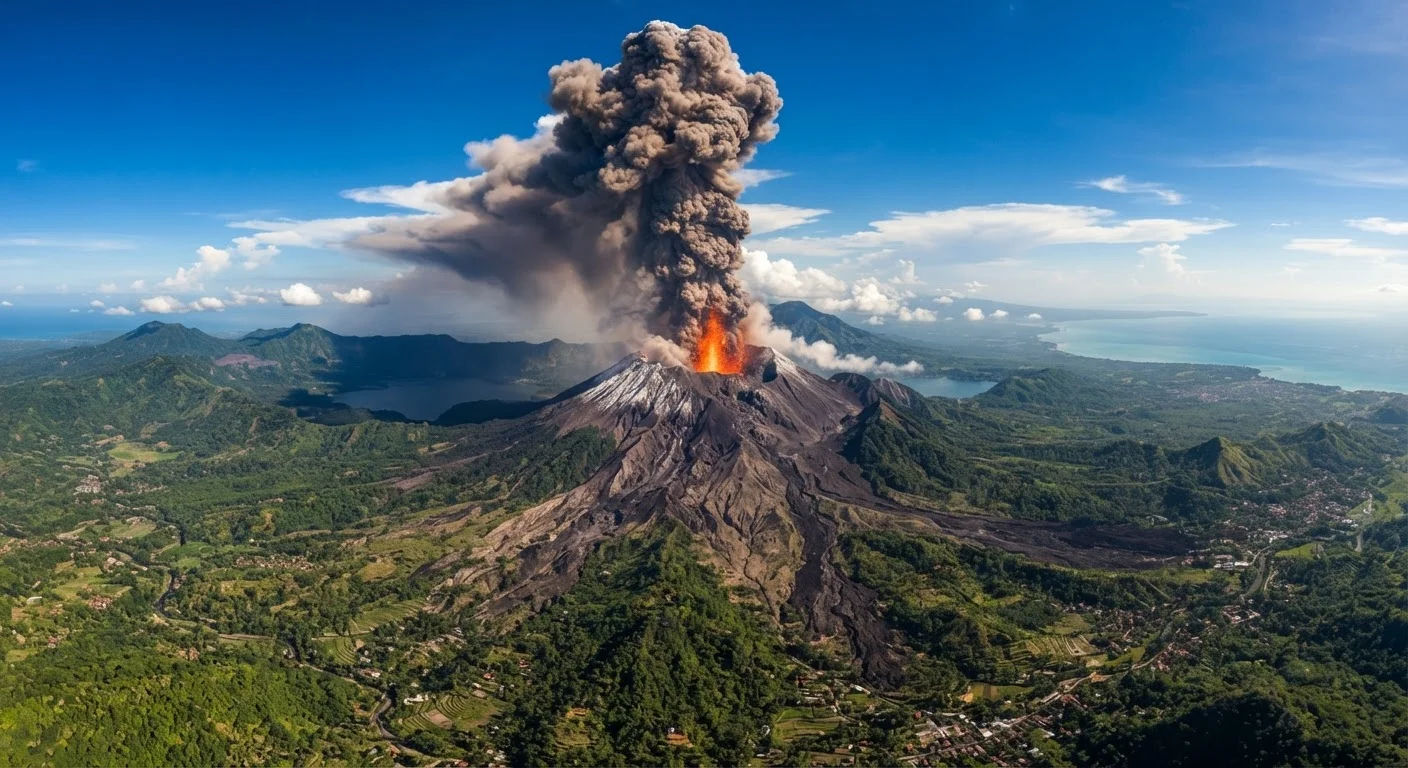
Stratovolcanoes are what most people picture: tall, symmetrical, steep-sided cones built up from alternating layers of hardened lava, ash, and pyroclastic debris. Their silica-rich magma is thick and gas-charged, meaning pressure builds dramatically before each eruption. The results can be catastrophic. Mount St. Helens (Washington), Mount Rainier, and Mount Fuji in Japan are all stratovolcanoes. The 1980 eruption of Mount St. Helens removed the entire north face of the mountain in seconds.
Cinder Cone Volcanoes
Cinder cones are the simplest and most common volcanic landform. They form from single vents that shoot blobs of molten rock - called cinders or scoria - into the air, which then fall back and pile up into a steep-sided cone. They tend to be small (rarely exceeding 1,000 feet tall), short-lived, and often appear on the flanks of larger volcanoes. Parícutin in Mexico famously grew from a cornfield in 1943 and is one of the youngest cinder cones ever documented.
Calderas
A caldera is not a constructive feature - it is a collapse. When a volcano empties its underground magma chamber rapidly during a massive eruption, the ground above it can cave in, forming a large depression known as a caldera. Yellowstone's famous hot springs and geysers sit inside one of the largest calderas in North America, the remnant of eruptions that occurred hundreds of thousands to millions of years ago. Crater Lake in Oregon fills another dramatic caldera left by the collapse of ancient Mount Mazama roughly 7,700 years ago.
Magma
Molten rock located beneath Earth's surface. Once it reaches the surface through a volcanic eruption, it is called lava.
Viscosity
A measure of a fluid's resistance to flow. High-viscosity magma is thick and sticky; low-viscosity magma flows easily. Viscosity largely determines whether an eruption is gentle or explosive.
Pyroclastic flow
A fast-moving current of hot gas, ash, and volcanic fragments that races down a volcano's slopes at devastating speed. Pyroclastic flows are among the most lethal volcanic hazards.
Caldera
A large, basin-shaped depression formed when a volcano's magma chamber empties and the overlying ground collapses inward. Calderas can be miles wide.
Basaltic lava
Iron- and magnesium-rich lava with low silica content and low viscosity. It flows easily and typically produces effusive, non-explosive eruptions characteristic of shield volcanoes.
Scoria
Solidified fragments of vesicular (bubble-filled) volcanic rock ejected from a vent. Scoria, sometimes called cinders, piles up to form cinder cone volcanoes.
Less-Common but Important Volcanic Features
Beyond the four main types, Earth's volcanic landscape includes several other notable structures worth knowing.
Lava domes form when viscous magma oozes out of a vent too slowly to flow far, piling up into a bulbous mound. They are inherently unstable - their collapse can trigger deadly pyroclastic flows. A lava dome grew inside the crater of Mount St. Helens after its 1980 eruption and periodically collapsed with dangerous results.
Supervolcanoes are not a formal geologic category but a popular term for calderas capable of eruptions many times larger than any in recorded human history. The Yellowstone system is frequently cited. These eruptions are exceedingly rare; scientists emphasize that the probability of a Yellowstone supereruption in any human lifetime is extremely low.
Volcanic fields - scattered clusters of vents spread over wide areas - exist where magma doesn't follow a single pathway. The Valles Caldera in New Mexico and parts of the American Southwest represent this diffuse style of volcanism.
Volcanoes are also found beyond Earth. Olympus Mons on Mars is a shield volcano roughly three times the height of Mount Everest, and active volcanism has been confirmed on Jupiter's moon Io, the most volcanically active body in the solar system.