
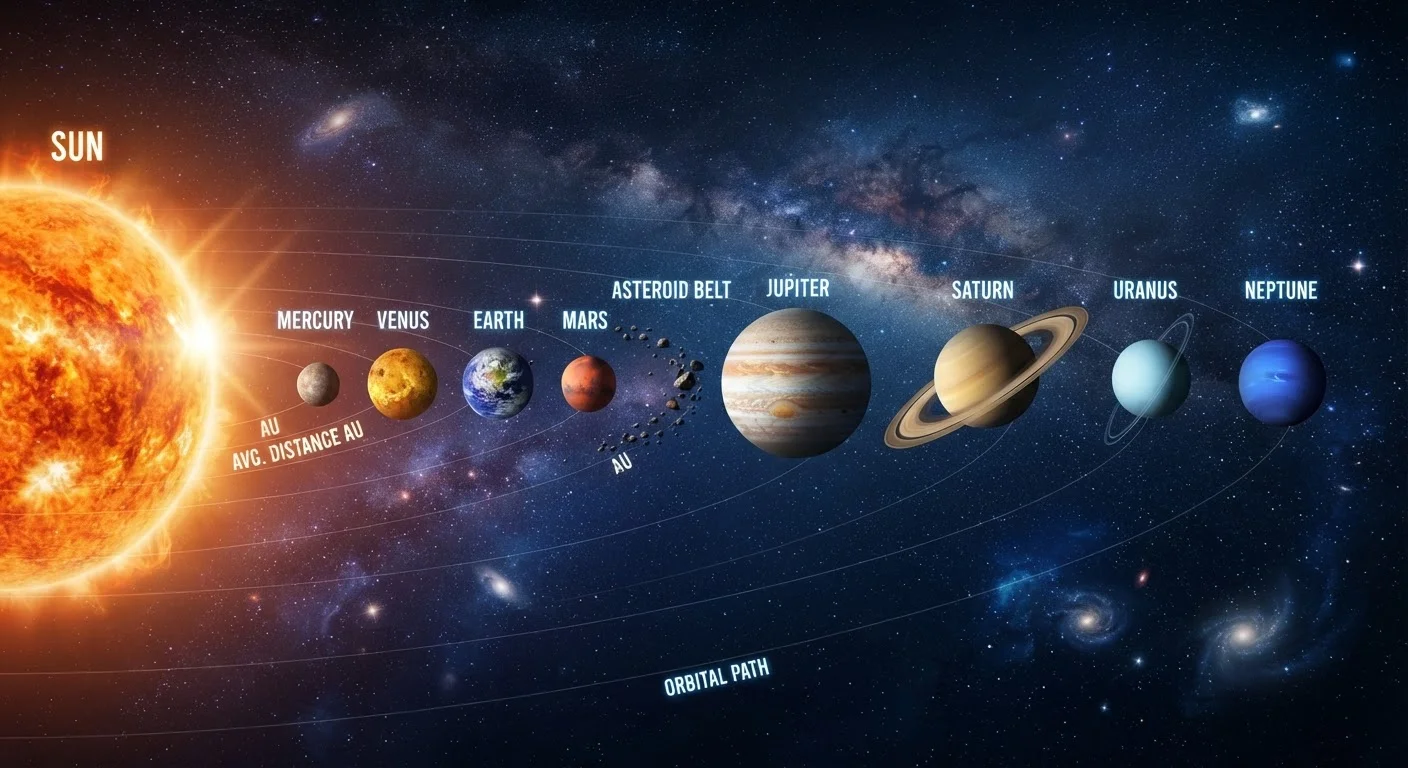
Why Human Intuition Fails at Solar System Distances
Our brains evolved to navigate a world measured in feet and miles. A cross-country drive of 2,800 miles feels enormous. The Moon, at roughly 239,000 miles away, already strains comprehension. But the solar system operates on a scale that makes even the Moon's distance feel trivial.
The Sun is about 93 million miles from Earth. That number lands differently when you consider that light - traveling at 186,000 miles per second - still takes approximately 8 minutes and 20 seconds to complete that journey. When you look at the Sun (safely, through appropriate filters), you are seeing it as it was more than eight minutes ago.
This is why astronomers invented the Astronomical Unit (AU). Rather than dealing with hundreds of millions or billions of miles, scientists can say Saturn sits about 9.5 AU from the Sun and Neptune about 30 AU. The numbers become manageable, even if the distances themselves remain staggering.
93 million miles
Average Earth-Sun distance (1 AU)
This baseline measurement, called the Astronomical Unit, is the standard ruler astronomers use to describe distances within the solar system.
~4.1 hours
Time for light to reach Neptune from the Sun
NASA uses light-travel time to calculate communication delays with deep-space missions; signals to a Neptune probe would face the same 4-plus-hour one-way lag.
100,000 AU
Estimated outer extent of the Oort Cloud
The Oort Cloud is thought to be the source of long-period comets; its outer boundary, if confirmed, would place it nearly halfway to the nearest star system.
Scale Models That Make It Click
The most effective way to grasp solar system scale is through physical analogy. One widely used model shrinks the Sun to the size of a standard basketball (about 9.4 inches in diameter). At that scale:
- Earth becomes roughly the size of a peppercorn, placed about 86 feet from the basketball.
- Jupiter - the solar system's largest planet - is about the size of a marble, sitting nearly 450 feet away.
- Neptune is another peppercorn-sized world, but now almost half a mile from the basketball Sun.
- The Oort Cloud, the solar system's outermost boundary, would extend more than 1,600 miles in every direction at this scale - roughly the distance from New York City to Denver.
These comparisons reveal a consistent truth: the solar system is overwhelmingly empty. The planets are tiny specks adrift in an enormous void.
Light-Travel Time: The Most Honest Ruler
Astronomers often describe cosmic distances using the time light takes to cross them - a method that makes scale viscerally real. Here's how light-travel time maps onto our solar system:
| Destination | Distance (AU) | Light-Travel Time |
|---|---|---|
| Moon | 0.0026 | ~1.3 seconds |
| Sun | 1 | ~8.3 minutes |
| Mars (average) | ~1.5 | ~12.5 minutes |
| Jupiter | ~5.2 | ~43 minutes |
| Neptune | ~30 | ~4.1 hours |
| Voyager 1 (mid-2020s) | >160 | ~22 hours |
This framing also explains why communicating with Mars rovers involves delays. A radio command sent from Earth reaches Mars in roughly 3 to 22 minutes depending on orbital position - and the rover's reply takes equally as long to return. There is no real-time conversation possible across interplanetary distances.
What the Numbers Tell Us About Space Exploration
Understanding scale puts human spaceflight ambitions in sharp perspective. The Apollo missions reached the Moon - that 1.3-light-second gap - in about three days. Mars, even at its closest approach, is hundreds of times farther away. A crewed Mars mission using current propulsion technology would take roughly six to nine months of travel time each way.
Voyager 1, which launched in 1977 and has been traveling continuously ever since, crossed into interstellar space around 2012. After more than four decades of flight, it has traveled just over 160 AU - not even close to the Oort Cloud's outer edge. The nearest star system, Alpha Centauri, sits about 276,000 AU away. At Voyager's speed, reaching it would take roughly 75,000 years.
These are not reasons for despair but for honest reckoning. The solar system's scale clarifies why advances in propulsion - whether ion drives, solar sails, or concepts still on the drawing board - are a scientific priority. Distance is not merely an inconvenience; it is the defining challenge of human exploration beyond Earth.
For everyday readers, the takeaway is simpler and perhaps more powerful: the next time you see a photograph of Earth from space, consider that even that vast blue sphere occupies a nearly invisible point in the solar system's real geometry. Scale, once truly understood, changes how you see the sky.