Why Earth's Atmosphere Is Layered
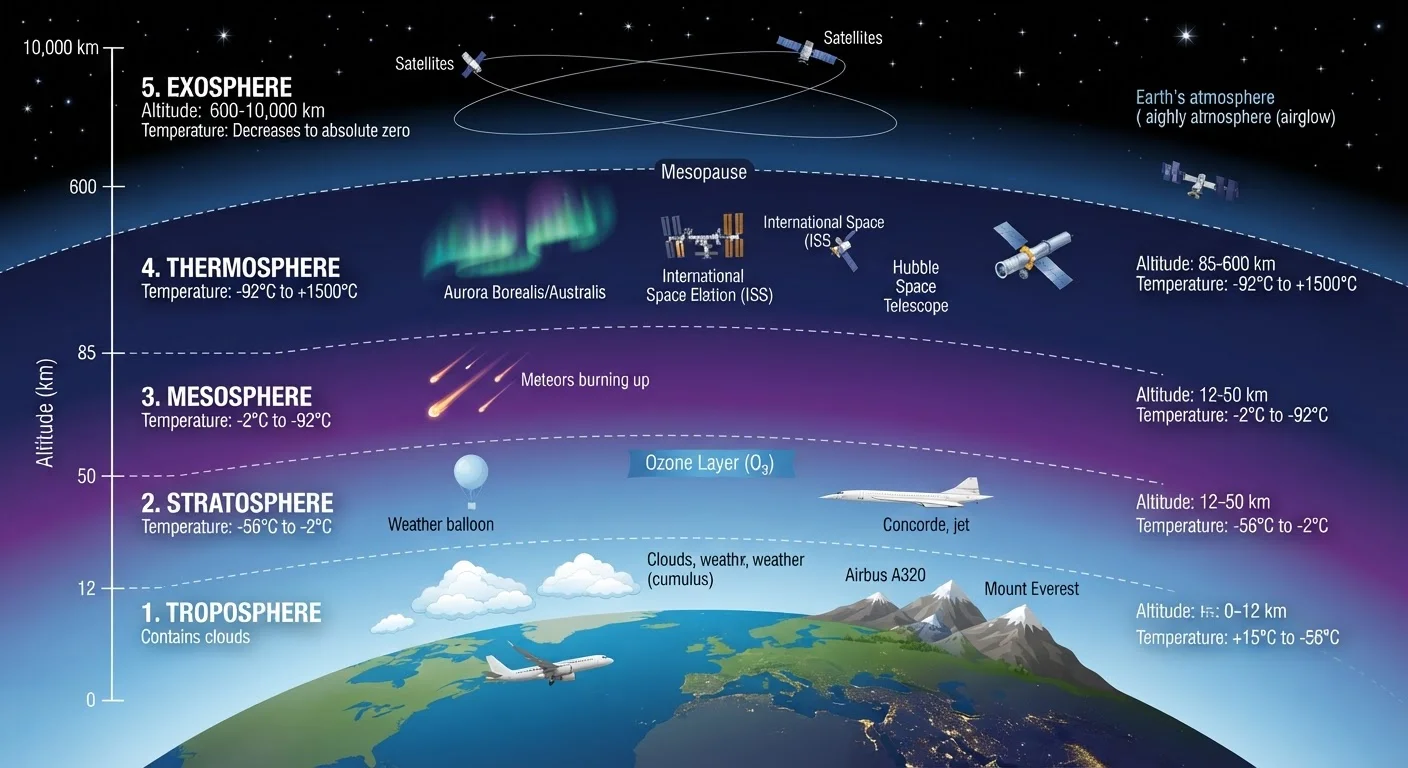
Earth's atmosphere isn't a uniform blanket of air - it's a stack of distinct layers, each defined primarily by how temperature behaves as altitude increases. In some layers, temperature drops steadily as you climb. In others, it rises sharply. These temperature profiles reflect differences in chemistry, density, and the types of energy at work in each zone.
Understanding these layers matters beyond textbook knowledge. Weather, aviation, GPS signals, satellite orbits, and even the survival of life on Earth all depend on the specific properties of each atmospheric layer. Here's what happens in each one, from the ground up.
| Total atmospheric depth | ~6,200 miles (10,000 km) to the outermost exosphere boundary (NASA Earth Science) |
| Layer closest to Earth's surface | Troposphere (0-12 miles) |
| Coldest atmospheric layer | Mesosphere (as low as −130°F / −90°C) (NOAA) |
| Where auroras occur | Thermosphere (~60-200 miles altitude) (NASA) |
| Where the ISS orbits | Thermosphere (~250 miles altitude) (NASA) |
| Layer protecting Earth from UV | Stratosphere (ozone layer, ~9-25 miles) (EPA) |
The Five Layers Explained
Troposphere: Where Weather Lives
The troposphere extends from Earth's surface to roughly 7-12 miles (11-20 km) up, depending on latitude. It contains about 75% of the atmosphere's total mass and nearly all of its water vapor. Every weather event - storms, clouds, precipitation, wind - originates here. Temperature drops about 3.5°F for every 1,000 feet of altitude gained, a rate called the environmental lapse rate. Commercial aircraft fly near the top of this layer, called the tropopause.
Stratosphere: Home of the Ozone Layer
Above the troposphere lies the stratosphere, reaching up to about 31 miles (50 km). Unlike below, temperature here increases with altitude, because the ozone layer absorbs ultraviolet radiation from the sun. This thermal inversion creates stable, calm air - which is why high-altitude research balloons and some military aircraft operate here. The ozone layer's protection against UV radiation is one of the most critical features in Earth's atmospheric system.
Mesosphere: Where Meteors Burn Up
The mesosphere spans from roughly 31 to 53 miles (50-85 km). Temperature drops again with altitude, making this the coldest region in the atmosphere - temperatures can plunge below −130°F (−90°C). This is where most meteoroids entering Earth's atmosphere burn up due to friction, creating the streaks we call shooting stars. Despite its importance, the mesosphere is notoriously difficult to study; it's too high for weather balloons and too low for satellites.
Thermosphere: Where the Aurora Dances
The thermosphere begins around 53 miles up and extends to roughly 375 miles (600 km). Here, temperatures skyrocket - potentially exceeding 3,600°F (2,000°C) - because gas molecules absorb intense solar radiation. However, the air is so thin that a thermometer would register extreme cold; there simply aren't enough molecules to transfer heat in a conventional sense. The International Space Station orbits within the thermosphere. Auroras (the northern and southern lights) occur here when charged solar particles interact with atmospheric gases.
Exosphere: The Fade to Space
The exosphere is the outermost layer, beginning around 375 miles and gradually fading into the vacuum of space, with no hard upper boundary. It's composed mostly of hydrogen and helium at extraordinarily low densities. Many weather and communications satellites operate in this region. Scientifically, the exosphere is where Earth's atmosphere ceases to behave as a coherent fluid and becomes a sparse scattering of individual atoms.
Tropopause
The boundary layer between the troposphere and stratosphere. It marks the altitude at which temperature stops falling with height, typically found between 7 and 12 miles above the surface.
Ozone Layer
A region within the stratosphere with a relatively high concentration of ozone (O₃) molecules. It absorbs the majority of the sun's harmful ultraviolet radiation before it reaches Earth's surface.
Environmental Lapse Rate
The rate at which air temperature decreases with increasing altitude in the troposphere, averaging approximately 3.5°F per 1,000 feet under standard conditions.
Aurora
Colorful light displays that occur in the thermosphere when energetic particles from the sun collide with and excite atmospheric gases, most visible near Earth's polar regions.
Thermal Inversion
A condition in which temperature increases with altitude rather than decreasing, as seen in the stratosphere. This creates stable, stratified air that resists vertical mixing.
Meteoroid
A small rocky or metallic body traveling through space. When it enters Earth's atmosphere and burns up due to friction, it is called a meteor - commonly known as a shooting star.