Why Your Eyes Are Enough
Modern astronomy began long before telescopes existed. Ancient navigators crossed oceans, and cultures worldwide built calendars, all by watching the unaided sky. The human eye is remarkably capable in the dark - its rod cells (specialized photoreceptors) can detect an extraordinary range of brightness once fully adapted to darkness.
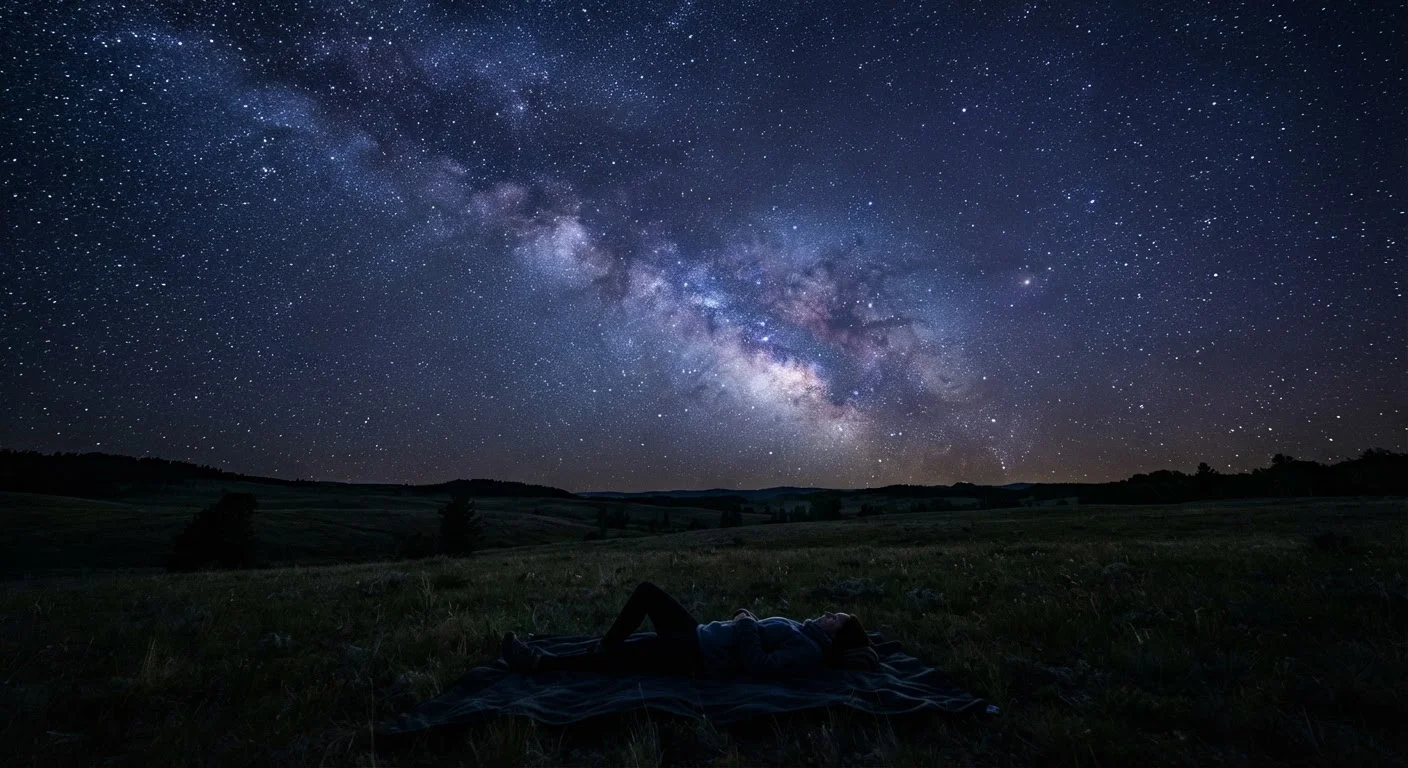
Under a truly dark sky, you can see the Milky Way's galactic band stretching overhead, watch meteors streak across the atmosphere, trace the shapes of dozens of constellations, and pick out five planets with no equipment at all. The limiting factor is almost never your eyes - it's the artificial light drowning out the sky around you.
Dark adaptation
The process by which your eyes become more sensitive to low light after being in darkness for 20-30 minutes, allowing you to see far fainter stars.
Light pollution
The brightening of the night sky caused by artificial lights from cities and roads, which scatters into the atmosphere and obscures stars.
Ecliptic
The imaginary line across the sky that traces the sun's apparent annual path; planets are always found close to this line.
Constellation
A named pattern of stars as seen from Earth, used for centuries to navigate and organize the sky into recognizable regions.
Milky Way
The galaxy that contains our solar system; its galactic core appears as a faint, cloudy band of light stretching across a truly dark sky.
Magnitude
The scale astronomers use to measure an object's brightness; lower (or negative) numbers mean brighter objects, so Venus at magnitude -4 outshines most stars.
Finding Dark Skies Near You
Light pollution - the scattering of artificial light into the atmosphere - is the primary enemy of stargazing. The good news: even a 30-to-60-minute drive away from a major metro area can transform your view. Rural areas, state forests, and farmland away from highway corridors are good starting points.
The Bortle scale rates sky darkness from Class 1 (pristine dark sky) to Class 9 (inner-city glow). Free online dark-sky maps - such as the Light Pollution Map tool - let you find Class 3 or 4 skies within reach of most American cities. Designated International Dark Sky Parks, recognized by DarkSky International (formerly the International Dark-Sky Association), offer protected, legally dark environments specifically managed for public stargazing.
Aim for nights within a few days of the new moon, when the moon is below the horizon or not yet risen - moonlight washes out faint stars much like artificial light does.
Learning to Read the Sky
The night sky changes predictably with the seasons because Earth's orbit shifts which constellations face away from the sun. A few anchor constellations make orientation much easier for beginners.
- Orion dominates winter evenings and is one of the most recognizable patterns, with three bright belt stars in a tight row.
- The Big Dipper (part of Ursa Major) is visible year-round for most Americans and points directly to Polaris, the North Star.
- Scorpius rises in the south during summer, its curved tail unmistakable on clear nights.
- The Summer Triangle - formed by the bright stars Vega, Deneb, and Altair - serves as a reliable summer and early autumn landmark.
Free apps such as SkySafari, Stellarium, or Google's Sky Map overlay constellation lines on your phone's live camera view, letting you point and identify in real time. Use them with brightness turned low to protect your dark adaptation.
Spotting Planets and Satellites
Planets are among the most rewarding naked-eye targets because they're reliably bright and move noticeably against the star background over days and weeks. Venus, Jupiter, Saturn, and Mars are all visible without any optical aid at their respective bright phases. They travel along the ecliptic - the sun's apparent path across the sky - so scanning that band is always productive.
Artificial satellites add a different kind of excitement. The International Space Station (ISS) crosses the sky in roughly three to six minutes and can be as bright as any star you'll see. It moves smoothly and steadily with no blinking - a key difference from aircraft. NASA's Spot the Station website provides free flyover alerts by zip code.
Meteor showers are another accessible spectacle. The Perseids (peaking around mid-August) and the Geminids (mid-December) reliably produce dozens of meteors per hour under dark skies. No equipment needed - just a reclining lawn chair and patience.
Tips for Your First Night Out
A few practical habits make the difference between a frustrating and a magical experience.
- Allow 20-30 minutes for dark adaptation. Stay away from white lights, including your phone screen, once you arrive. Your eyes' sensitivity increases dramatically over this period.
- Dress for the cold. Even summer nights can drop 20°F after sunset. Layers and a warm hat go a long way.
- Lie down. A blanket or reclining chair lets you scan a wide swath of sky comfortably without neck strain.
- Start with the brightest targets. Identify a planet, the Big Dipper, or the Moon's craters (binoculars optional) before hunting for faint objects.
- Keep a small notebook. Sketching what you see helps you remember it and notice changes night to night.
Use Red Light, Not White
Switching to a red-light headlamp is one of the single most effective upgrades for naked-eye stargazing. White light floods your retinas and resets 20 minutes of dark adaptation in seconds. Red light lets you read a star chart or check your phone without losing your night vision. Many headlamps include a red-light mode - check before you buy a separate one.
Stargazing is a skill that compounds - each outing builds your mental map of the sky, and objects that seemed invisible become familiar landmarks. Give yourself several sessions before expecting to find everything.