A Shared Origin, A Divergent Destiny
When a star much more massive than our Sun exhausts its nuclear fuel, it dies in spectacular fashion. The core, no longer producing outward pressure from fusion, collapses under its own gravity in a fraction of a second - triggering a supernova explosion that briefly outshines entire galaxies. What's left behind depends almost entirely on mass.
If the collapsed core weighs in at roughly one to three times the mass of the Sun, it becomes a neutron star - an object about 12-15 miles across but packed with more mass than the Sun itself. If the core is heavier, gravity wins completely, and a black hole forms. Same catastrophic process, two radically different outcomes.
This mass threshold isn't a sharp line drawn by nature - scientists still study the exact boundary - but the underlying principle is well-established: it comes down to whether any known force can resist gravitational collapse.
What Makes Each One Different
A neutron star still has a surface. It is made almost entirely of neutrons - subatomic particles - packed so tightly that a sugar-cube-sized scoop would weigh roughly a billion tons on Earth. It obeys known physics, including quantum mechanics. This is why neutron stars can support themselves: a quantum phenomenon called neutron degeneracy pressure pushes back against gravity.
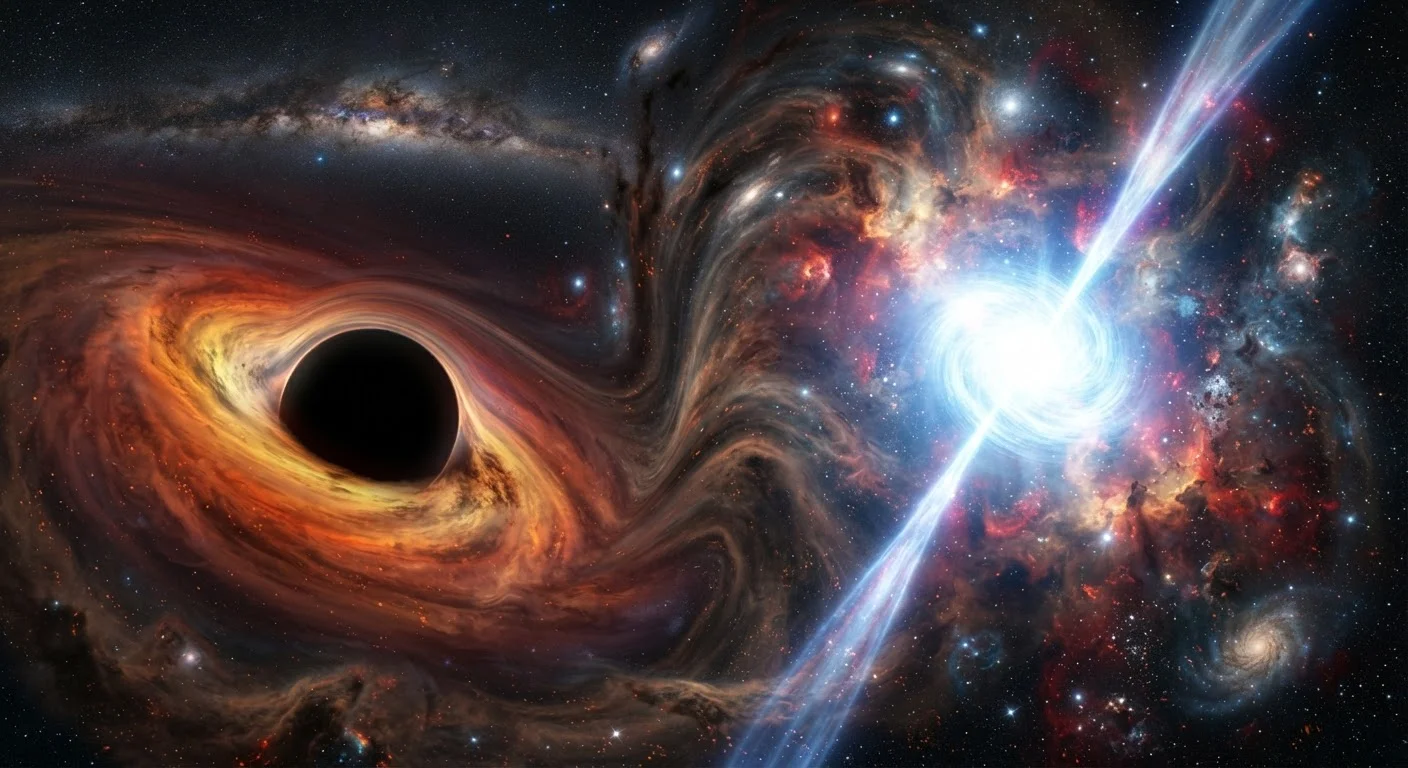
A black hole, by contrast, has no surface you could land on. It has an event horizon - a boundary beyond which the escape velocity exceeds the speed of light. Anything crossing that boundary, including light, cannot return. At the center is a singularity, a point where current equations predict infinite density - a sign that our physics is incomplete, not that infinity literally exists there.
| Criterion | Black Hole | Neutron Star |
|---|---|---|
| Has a physical surface | No - event horizon only | Yes - solid neutron-packed surface |
| Typical mass range | ~3 solar masses and above | ~1 to 3 solar masses |
| Typical size | Event horizon: a few miles to millions of miles | About 12-15 miles in diameter |
| Directly observable? | Only indirectly (accretion, orbits) | Yes - emits light, X-rays, radio waves |
| What resists collapse | Nothing - gravity wins completely | Neutron degeneracy pressure |
| Gravitational wave source | Yes - from mergers | Yes - especially from mergers |
| Contains a singularity | Yes (predicted by current theory) | No |
One practical consequence: neutron stars radiate energy. Many spin rapidly and emit beams of radio waves like cosmic lighthouses - these are called pulsars. Black holes, unless they are actively consuming nearby matter and generating an accretion disk, are essentially invisible. The famous 2019 image of the black hole in galaxy M87 captured that glowing accretion disk, not the black hole itself.
How Scientists Detect Them
Neutron stars are among the most precisely measurable objects in astronomy. Pulsars tick so reliably that they rival atomic clocks, allowing scientists to test general relativity and map the galaxy. The 2017 detection of gravitational waves from a neutron star merger (GW170817) was simultaneously observed across the electromagnetic spectrum - a landmark moment for multi-messenger astronomy.
Black holes require indirect detection. Astronomers infer stellar-mass black holes by watching how they influence a companion star's orbit or by tracking X-ray emissions from superheated material spiraling into them. Supermassive black holes - millions to billions of solar masses, found at the centers of galaxies including our own Milky Way - are identified by the orbital speeds of nearby stars.
~1 billion tons
Mass of a sugar-cube of neutron star material
This estimate is based on the average density of neutron stars, as described in standard astrophysics literature.
6.5 billion
Solar masses of M87's central black hole
The Event Horizon Telescope Collaboration published this measurement alongside the first black hole image in 2019.
GW170817
First neutron star merger detected in gravitational waves
Detected by LIGO and Virgo in August 2017, it was also observed by telescopes across the electromagnetic spectrum.
Both types of objects continue to reshape how we understand space, time, and matter. Far from abstract curiosities, they are active participants in the structure and evolution of the universe around us.