Two Systems, One Goal
Your immune system isn't a single organ or a uniform force - it's two overlapping but fundamentally different defense networks working in coordination. Immunologists broadly divide immunity into the innate and adaptive arms, and understanding how each works explains a surprising amount about everyday experiences: why you spike a fever, why vaccines take time to work, and why your body rarely gets the same cold twice in the same way.
The innate system is ancient in evolutionary terms - insects, worms, and even plants have versions of it. The adaptive system is exclusive to vertebrates and represents a more sophisticated biological innovation. In humans, both are essential, and neither works well in isolation.
| Criterion | Innate Immunity | Adaptive Immunity |
|---|---|---|
| Response speed | Minutes to hours | Days to weeks |
| Specificity | Broad (recognizes pathogen classes) | Highly specific (targets single antigens) |
| Memory | None - same response every time | Yes - memory cells persist long-term |
| Key cell types | Neutrophils, macrophages, NK cells | B cells, T cells |
| Primary outputs | Inflammation, phagocytosis, cytokines | Antibodies, cytotoxic killing, memory |
| Evolutionary age | Ancient - shared across many species | Newer - found only in vertebrates |
| Role in vaccination | Provides initial activation signal | Generates lasting protective memory |
Innate Immunity: Speed Over Specificity
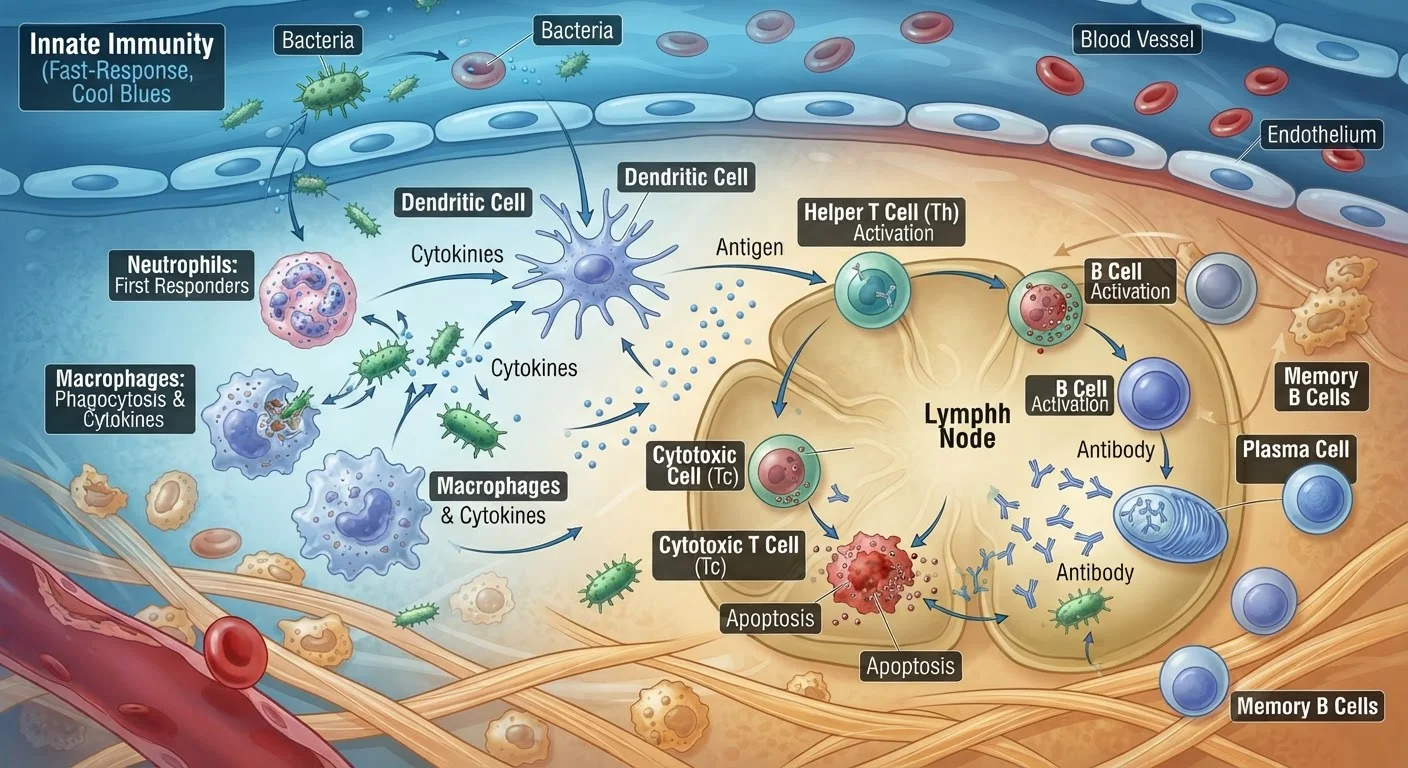
When a pathogen - whether a bacterium, virus, or fungal spore - breaches the body's physical barriers like skin or mucous membranes, the innate immune system activates almost immediately. This system relies on pattern recognition: specialized receptors on innate immune cells detect broad molecular signatures shared by many microbes, such as certain proteins found on bacterial cell walls. These signatures are called pathogen-associated molecular patterns, or PAMPs.
The innate response involves several key players: neutrophils, which engulf and destroy invaders; macrophages, which consume pathogens and signal other immune cells; and natural killer (NK) cells, which destroy infected or abnormal cells. This arm also triggers inflammation - a controlled local response that increases blood flow and recruits more immune cells to the site of infection. For a deeper look at when that process goes wrong, see how inflammation can overshoot its target.
Crucially, the innate system does not learn or remember specific threats. It responds the same way every time it encounters a given class of pathogen, making it fast but ultimately limited against complex, fast-evolving microbes.
Adaptive Immunity: Precision and Memory
The adaptive immune system takes days to mount a meaningful response, but what it produces is far more precise and durable. Its two main cell types - B cells and T cells - are generated in the billions, each with a unique receptor capable of recognizing a specific molecular target called an antigen. When a B or T cell encounters its matching antigen (often presented to it by innate immune cells acting as messengers), it multiplies rapidly and launches a targeted attack.
B cells produce antibodies - proteins that bind to specific pathogens or toxins, neutralizing them or marking them for destruction. Cytotoxic T cells hunt down and kill infected cells directly. Helper T cells coordinate the overall response, activating both B cells and other T cells.
After the infection is cleared, a subset of these activated cells persists as memory cells. The next time the body encounters the same pathogen, these memory cells enable a dramatically faster and stronger response - often eliminating the threat before symptoms even appear. This is immunological memory, and it's the biological principle that makes vaccines effective.
~10 billion
Unique B and T cell receptors possible
The human adaptive immune system can theoretically generate around 10 billion distinct receptor configurations, enabling recognition of a vast range of antigens.
7-14 days
Time to peak adaptive response in new infection
Immunology textbooks consistently cite roughly one to two weeks for a primary adaptive response to reach full effectiveness against a novel pathogen.
Decades
Duration of some immunological memory
Research on survivors of historical outbreaks, including a landmark study published in Nature, found measurable B cell memory persisting for over 60 years after infection.
How the Two Systems Work Together
Innate and adaptive immunity are not independent - they are deeply interconnected. The innate system serves as a rapid first responder and as a critical signal to the adaptive system that a genuine threat is present. Without those danger signals from innate cells, the adaptive system may not fully activate, even when a pathogen is present.
This cooperation also explains why vaccine adjuvants - ingredients added to some vaccines - work the way they do. Adjuvants stimulate innate immune pathways, generating the inflammatory context the adaptive system needs to mount a strong, lasting response to the vaccine's antigens.
When either system fails or misfires, disease follows. Deficiencies in innate immunity increase vulnerability to a wide range of infections. Defects in adaptive immunity - as seen in certain genetic conditions or in HIV, which depletes helper T cells - leave the body dangerously exposed to pathogens that a healthy immune system would handle routinely. Conversely, an overactive adaptive system that fails to distinguish self from non-self can lead to autoimmune diseases, where the body attacks its own tissues.
This article is for general educational purposes only and is not a substitute for professional medical advice. Consult a qualified healthcare provider with any questions about your immune health or medical conditions.