Life Finds a Way - Even Where It Shouldn't
For most of human history, scientists assumed that life required moderate temperatures, liquid water at surface pressure, and roughly Earth-level radiation. That assumption has been dismantled, experiment by experiment, as biologists discovered organisms thriving in boiling hot springs, solid Antarctic ice, crushing ocean trenches, and highly acidic mine drainage. These organisms are collectively called extremophiles - life forms that don't merely tolerate extreme conditions but are often dependent on them.
Understanding how they do it isn't just an academic curiosity. Each adaptation is a real-world proof of concept - a biological engineering solution refined over millions of years. The findings inform the search for extraterrestrial life and open doors to new materials, enzymes, and medicines. Here are some of the most striking examples of life's ingenuity under pressure.
Tardigrades: Surviving the Vacuum of Space
Tardigrades - microscopic animals roughly half a millimeter long - are arguably the most resilient organisms ever documented. When conditions become hostile, they enter a state called cryptobiosis, expelling nearly all water from their cells and replacing it with a sugar called trehalose, which forms a glass-like shield around cellular structures. In this dried-out state, called a tun, tardigrades can survive vacuum exposure, temperatures close to absolute zero (−272°C), and radiation doses hundreds of times lethal to humans. Laboratory experiments confirmed they survived brief exposure to open space conditions aboard a European Space Agency mission. Their biology essentially hits a biological pause button, protecting DNA and proteins until liquid water returns.
Tardigrades survive space-level vacuum by replacing cell water with a glass-like sugar shield.
Deep-Sea Fish: Engineered for Crushing Pressure
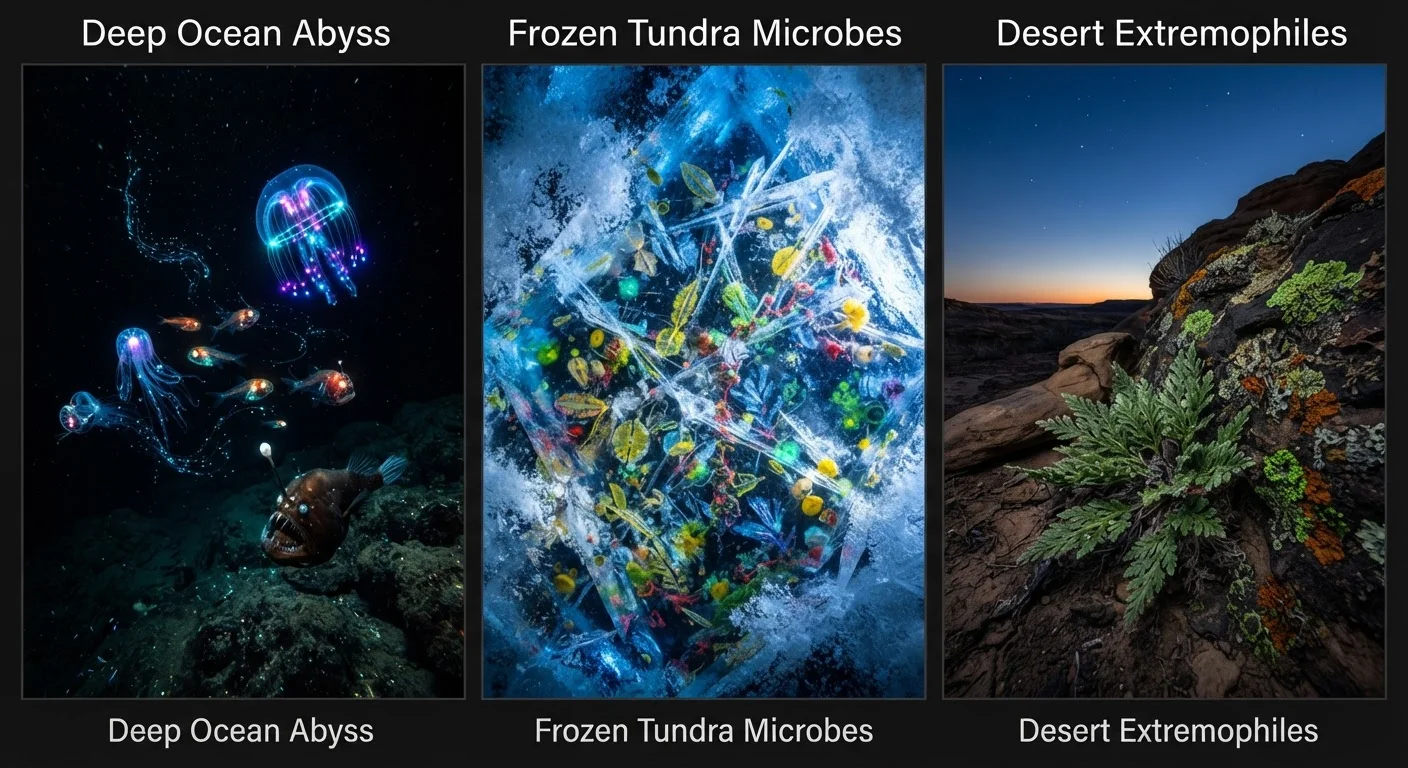
At depths below 6,000 meters - such as the Mariana Trench - pressure exceeds 600 times that at sea level. At those pressures, proteins and cell membranes in ordinary organisms would collapse entirely. Deep-sea fish like the Pseudoliparis swirei (a snailfish found at record depths) cope through two primary adaptations. First, their cell membranes are rich in unsaturated fats that remain flexible under compression. Second, their tissues are loaded with a compound called trimethylamine oxide (TMAO), which counteracts the pressure-induced distortion of proteins and keeps enzymes functional. TMAO concentration in fish tissues scales almost perfectly with the depth at which a species lives - a remarkable example of chemistry tracking physics.
TMAO concentration in deep-sea fish scales almost perfectly with the depth at which they live.
Thermophiles: Thriving in Boiling Water
Yellowstone's hot springs host bacteria and archaea that grow optimally at temperatures between 70°C and 120°C - conditions that denature (unfold and destroy) the proteins of most organisms almost instantly. Thermophiles solve this with proteins that have extra chemical cross-links and a higher proportion of heat-stable amino acid bonds, making their molecular machinery rigid enough to function where others would fall apart. The archaeon Pyrolobus fumarii was long considered the heat record-holder, growing at up to 113°C. Heat-stable DNA polymerase enzymes derived from thermophilic bacteria - most famously Thermus aquaticus from Yellowstone - now power PCR machines in labs worldwide.
Heat-stable enzymes from Yellowstone bacteria now power the genetic testing used in labs globally.
Desert Resurrection Plants: Rebuilding After Desiccation
The rose of Jericho (Selaginella lepidophylla) and similar resurrection plants can lose up to 95% of their water content, curl into a dry, apparently dead husk, and then fully rehydrate and resume photosynthesis within hours of rain. Unlike most plants, which die if they lose more than about 10-20% of cellular water, resurrection plants produce specialized proteins that stabilize membranes during drying and prevent the structural collapse of cells. They also ramp up antioxidant production to neutralize the reactive molecules that accumulate during desiccation. This adaptation evolved multiple times independently across different plant lineages - a classic example of convergent evolution solving the same problem with similar molecular tools.
Resurrection plants can lose 95% of their water and fully recover within hours of rainfall.
Psychrophiles: Life Engineered for Permanent Freeze
While most organisms shut down near freezing, psychrophiles (cold-loving organisms) thrive in Antarctic ice, sub-zero ocean waters, and glacial soils. Their adaptations are essentially the mirror image of thermophiles. Their enzymes are built with fewer stabilizing bonds, making them highly flexible at low temperatures - a necessary trade-off because molecular motion slows dramatically in the cold. Their cell membranes contain high concentrations of unsaturated and polyunsaturated fatty acids to prevent rigidity and maintain permeability. Some produce antifreeze proteins that bind to ice crystals and physically block them from growing larger - preventing the cell-shredding damage that ice expansion would otherwise cause.
Antifreeze proteins in psychrophiles physically bind to ice crystals and block them from growing.
Radiotrophic Fungi: Feeding on Radiation
Perhaps the most counterintuitive adaptation of all: fungi discovered growing on the walls of the damaged Chernobyl reactor appear to use ionizing radiation as an energy source - a process called radiosynthesis. These fungi contain high concentrations of the pigment melanin, which in this context may capture energy from gamma radiation in a way that is loosely analogous to how chlorophyll captures sunlight. Research published in peer-reviewed journals confirmed that radiation actually accelerated the growth of these melanin-rich fungi. The mechanisms are still being studied, but the implication is profound: what kills most life can, for some organisms, be a nutrient source. Potential applications include radiation-shielding materials and life-support systems for long-duration space missions.
Melanin-rich fungi at Chernobyl may use gamma radiation as an energy source to drive growth.
What Extremophiles Tell Us About Life's Potential
Every organism on this list represents a hard-won biological solution to a problem that seemed unsolvable. Collectively, they expand the known boundaries of habitability - on Earth and potentially elsewhere in the solar system. Scientists studying extremophiles have already adapted heat-stable enzymes from hot-spring bacteria into the PCR technique that underpins modern genetic testing. The field continues to deliver practical breakthroughs alongside profound scientific insight.
A Note on Astrobiology
Extremophile research directly shapes the search for life on other worlds. Environments like Europa's subsurface ocean or Mars's ancient hydrothermal systems are extreme by human standards - but not necessarily by the standards of what life on Earth has already demonstrated it can handle. Astrobiologists use known extremophile tolerances to define realistic habitability windows for other planets.
What unites all these organisms is not toughness in the colloquial sense, but precision. Each adaptation is exquisitely matched to its specific stressor. That specificity is a reminder that evolution doesn't build general-purpose fortresses - it builds tailored solutions. The more extreme environments we explore, the more solutions we find.