The Blueprint Inside Every Cell
Tucked inside the nucleus of almost every cell in your body is roughly six feet of DNA - coiled, compressed, and organized so efficiently it fits inside a space far smaller than the period at the end of this sentence. That DNA is your genome: a complete set of instructions for building and maintaining you.
But DNA itself does nothing. It is more like a master reference book kept locked in a library vault. To use those instructions, the cell must copy specific pages and send them out to where the work actually happens. That copying-and-carrying process is what the central dogma describes.
The concept was laid out by molecular biologist Francis Crick in 1958, and it remains one of the most powerful organizing ideas in all of science. Understanding it helps explain everything from how your body heals a cut to why certain inherited diseases occur - and how modern medicine increasingly targets these molecular steps.
Step One: Transcription - Reading the DNA
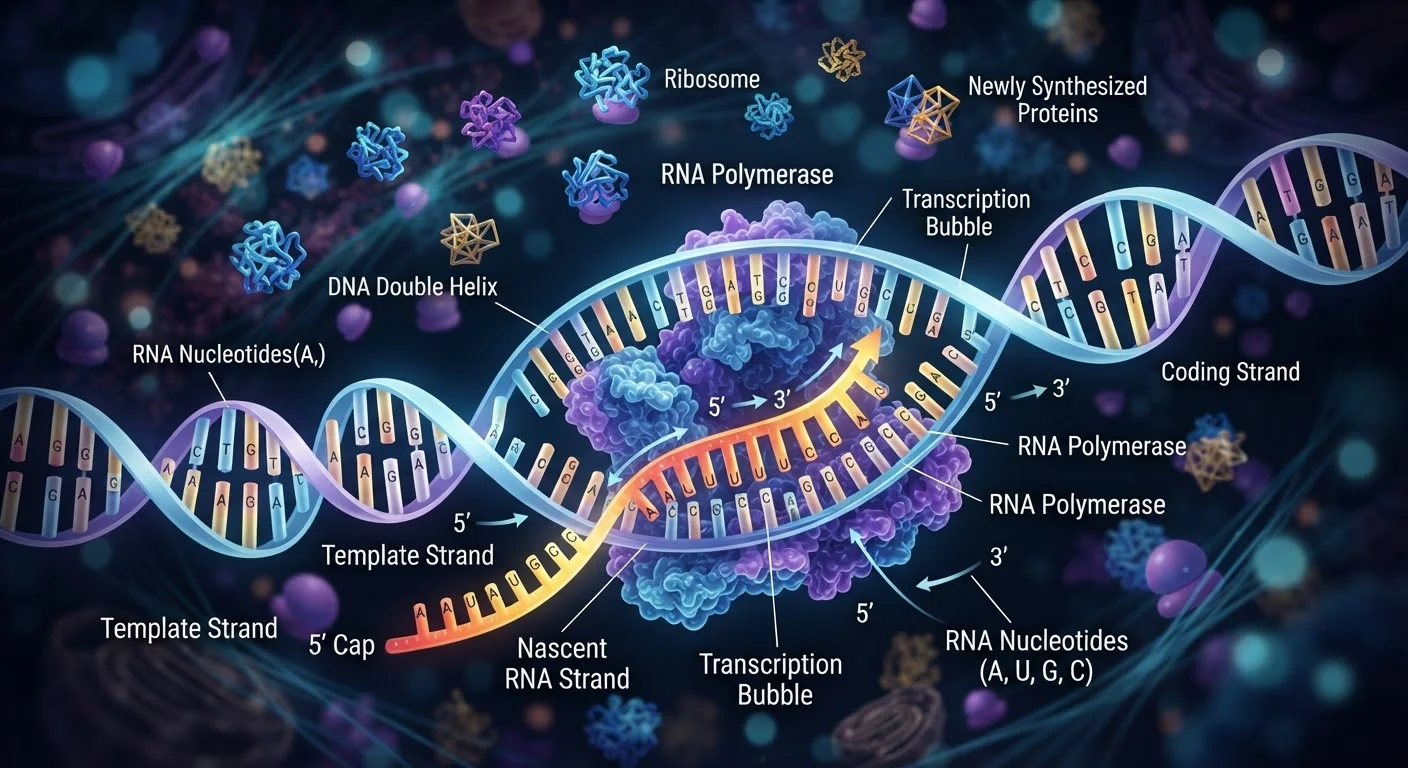
The first stage is called transcription, and it happens in the cell's nucleus. When a gene needs to be expressed - meaning its protein needs to be made - an enzyme called RNA polymerase binds to a specific region of the DNA strand and begins moving along it, reading the sequence of chemical letters (called nucleotide bases: adenine, thymine, guanine, and cytosine in DNA).
As the enzyme moves, it builds a complementary RNA molecule using a slightly different chemical alphabet. The resulting molecule is called messenger RNA, or mRNA. It is a single-stranded, mobile copy of the gene's instructions. Once complete, the mRNA is processed and exits the nucleus through tiny pores in the nuclear membrane.
RNA Is More Than Just a Messenger
While mRNA gets the most attention, cells produce many other types of RNA with distinct jobs. Ribosomal RNA (rRNA) forms the structural core of ribosomes. Transfer RNA (tRNA) carries amino acids during translation. Small regulatory RNAs can silence specific genes. The discovery of these diverse RNA roles has significantly expanded scientists' understanding of how gene expression is controlled.
Think of transcription as a librarian photocopying one specific page from the master manual so a worker in another room can use it - without ever removing the original book from the vault.
Step Two: Translation - Building the Protein
Once mRNA reaches the cell's cytoplasm, it is picked up by structures called ribosomes - molecular machines that read the mRNA sequence three letters at a time. Each three-letter unit is called a codon, and each codon specifies a particular amino acid, the building blocks of proteins.
Adapter molecules called transfer RNA (tRNA) ferry the correct amino acids to the ribosome in the right order. As each amino acid is added to the growing chain, a chemical bond links it to the previous one. When the ribosome reaches a stop codon, assembly ends and the newly built protein folds into its functional three-dimensional shape.
The protein then goes on to do its job - whether that is carrying oxygen through the bloodstream (hemoglobin), breaking down food (digestive enzymes), or relaying signals between nerve cells (neurotransmitter receptors).
~20,000
Protein-coding genes in the human genome
According to estimates from the Human Genome Project and subsequent analyses, humans have approximately 20,000-25,000 protein-coding genes out of roughly 3 billion DNA base pairs.
300,000+
Distinct proteins estimated in the human body
Research suggests the human proteome - the complete set of proteins an organism can produce - may contain over 300,000 unique forms, thanks to alternative splicing and post-translational modifications.
~40 seconds
Time for a ribosome to build one average protein
Studies of ribosome translation speed indicate that human ribosomes incorporate roughly 3-5 amino acids per second, meaning a 100-200 amino acid protein can be assembled in under a minute.
Why This Matters for Your Health
The central dogma is not an abstract textbook concept - it is the molecular basis of how diseases develop and how many treatments work. A mutation in a DNA sequence can alter the mRNA produced, and therefore the shape and function of the resulting protein. In sickle cell disease, for instance, a single-letter change in the gene for hemoglobin produces a misshapen protein that distorts red blood cells.
Gene therapies, mRNA vaccines, and CRISPR-based tools all operate by intervening at specific points in this pathway - correcting faulty DNA, delivering better instructions via mRNA, or blocking a harmful protein from being produced. Understanding where in the chain a problem originates is what allows researchers to design precise solutions.
The elegance of the central dogma is that it is universal. From bacteria to blue whales, the same three-step logic - DNA stores, RNA carries, proteins act - governs how life builds itself, moment by moment, cell by cell.