
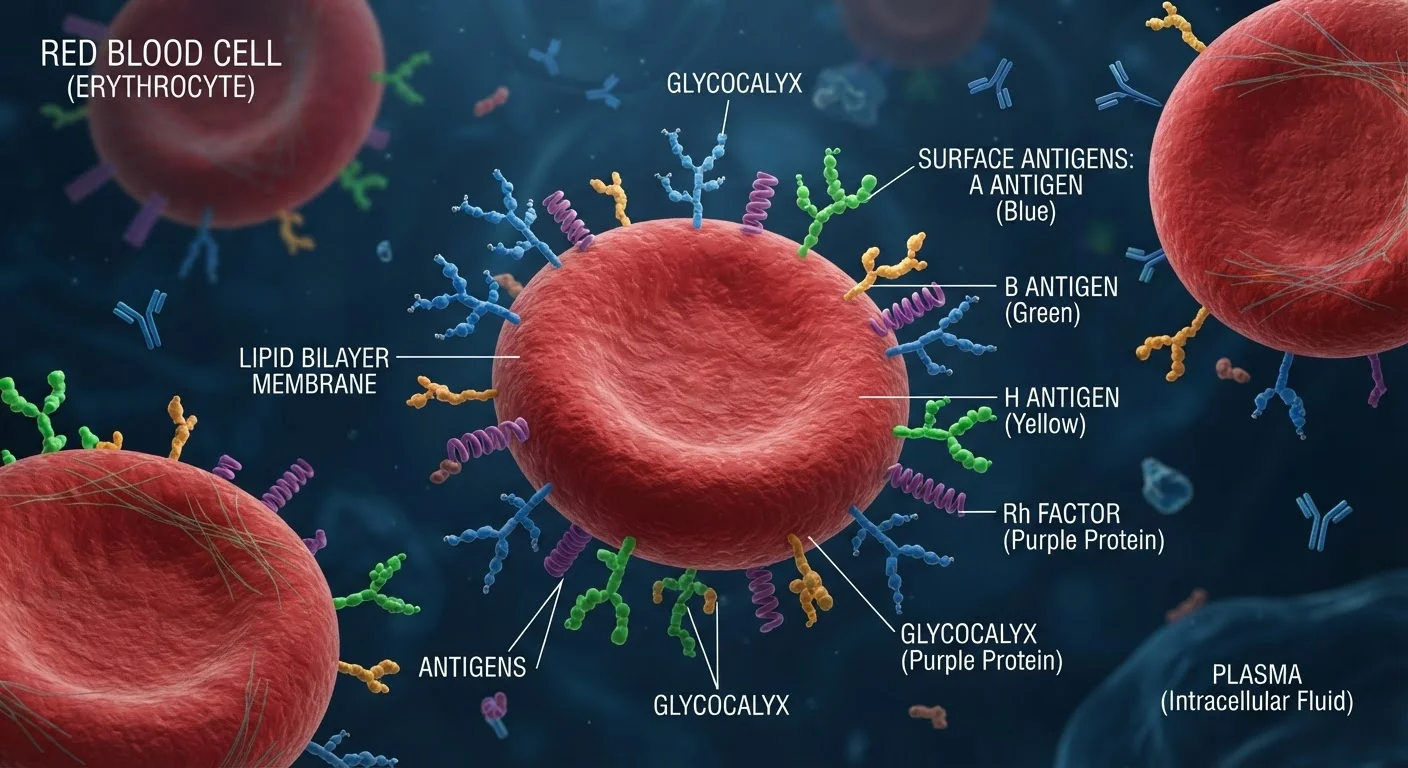
The Surface of a Red Blood Cell Is Not Blank
Imagine the outer surface of every red blood cell as a molecular landscape - studded with proteins and sugar chains that project outward like flags. These structures are called antigens, and they serve as identity markers that your immune system learns to recognize as 'self.' Blood typing is essentially a system for cataloging which flags each person's red blood cells are flying.
There are more than 30 recognized blood group systems, but the two that matter most clinically - and that appear on every blood donor card - are ABO and Rh. Together, they describe the most immunologically significant antigens on human red blood cells.
More Than Two Systems Exist
ABO and Rh get the most attention, but the International Society of Blood Transfusion recognizes over 30 distinct blood group systems, including Kell, Duffy, and Kidd. These matter primarily for patients who require frequent transfusions - such as those with sickle cell disease - where repeated mismatches in minor systems can still provoke immune reactions.
The ABO System: A and B Antigens, and the Antibodies That Follow
The ABO blood group is defined by two antigens: antigen A and antigen B. Whether your red blood cells carry one, both, or neither determines your ABO type:
- Type A: Red blood cells carry A antigens. Your plasma contains anti-B antibodies.
- Type B: Red blood cells carry B antigens. Your plasma contains anti-A antibodies.
- Type AB: Red blood cells carry both A and B antigens. Your plasma contains neither antibody.
- Type O: Red blood cells carry neither antigen. Your plasma contains both anti-A and anti-B antibodies.
The critical detail here is the antibody side. Unlike most immune responses that require prior exposure to develop, ABO antibodies form naturally in the first months of life - likely triggered by similar antigens found on common environmental bacteria and food. This means your immune system is already armed against incompatible blood types without any prior transfusion or exposure.
The Rh System: One Protein That Changes Everything
Layered onto the ABO system is the Rh classification, which is far simpler at the basic level: it asks whether your red blood cells carry a protein called the Rh D antigen (also written as antigen D). If you have it, you're Rh-positive (+). If you don't, you're Rh-negative (−).
Unlike ABO antibodies, anti-Rh antibodies do not develop automatically. An Rh-negative person only begins producing anti-D antibodies after being exposed to Rh-positive blood - either through a transfusion or, more commonly, during pregnancy when small amounts of fetal blood cross into the mother's circulation.
This distinction becomes critical during pregnancy. An Rh-negative mother carrying an Rh-positive baby faces no problem in the first pregnancy because sensitization takes time. But in subsequent pregnancies, pre-formed maternal anti-D antibodies can cross the placenta and attack fetal red blood cells - a condition called hemolytic disease of the fetus and newborn (HDFN). This is why prenatal blood type screening and preventive Rh immunoglobulin treatment exist.
“The ABO blood group system remains the most important of all blood group systems in transfusion medicine because naturally occurring antibodies in the plasma make ABO-incompatible transfusions immediately life-threatening.”
— Nareg Roubinian, Transfusion medicine researcher, Vitalant Research Institute
Why Compatibility Rules Are So Precise
When blood types are mismatched in a transfusion, the recipient's existing antibodies immediately begin binding to the foreign antigens on donor red blood cells. This triggers a cascade - the complement system activates, immune cells pile on, and the donated cells are rapidly destroyed. In severe cases, this hemolytic reaction can cause kidney failure and shock.
Blood banks therefore perform multiple compatibility tests before any transfusion, including a crossmatch that literally mixes donor and recipient blood in a lab to check for visible clumping (agglutination). The cellular logic is elegant: antigens and antibodies lock together like a molecular key-and-lock, and the immune system treats anything that binds as a threat.
~45%
Share of Americans with type O blood
According to the American Red Cross, approximately 45% of the U.S. population has type O blood (positive or negative combined), making it the most common ABO type.
~85%
Americans who are Rh-positive
Roughly 85% of the U.S. population carries the Rh D antigen, meaning they are Rh-positive; the remaining ~15% are Rh-negative.
30+
Recognized human blood group systems
The International Society of Blood Transfusion recognizes more than 30 distinct blood group systems, though ABO and Rh remain the most clinically significant for transfusion and pregnancy.
The Genetics: Why Blood Type Runs in Families
ABO blood type is controlled by a single gene with three common alleles - IA, IB, and i. The A and B alleles are codominant, meaning that if you inherit one of each, both antigens are produced (resulting in type AB). The O allele produces no functional antigen and is recessive - you need two copies to be type O.
Rh status is governed by a separate gene cluster. The key gene is RHD; people who carry at least one functional copy produce the D antigen and are Rh-positive. Rh-negative individuals typically have a deletion or non-functional version of RHD on both chromosomes.
Two type O parents can only produce type O children. Two type AB parents cannot produce a type O child. Understanding these rules has long been used in paternity investigations and genetic counseling - though modern DNA testing has largely replaced blood typing for those purposes.
This article provides general scientific education and is not a substitute for medical advice. Always consult a qualified healthcare provider for any health-related concerns or decisions.